
The Broken Front Wheel
Have you ever gotten stuck with one of those janky shopping carts with a broken front wheel?
It’s briefly smooth sailing as you head for the avocados, but then the wheel catches and pulls the cart (and you) to an awkward and unexpected stop. You wiggle and jiggle and manage to get the cart moving only for it to immediately refuse to make the turn around an end cap loaded with bananas. You lift the back end a little and use the front wheels as a pivot point. The good cheese isn’t far, so you just leave the cart parked out of the way and walk over to retrieve your smoked gouda.
Wrangling your cart through the store starts to feel like trying to push a mini fridge over coarse gravel. You adjust your approach — you don’t wander, you map out the most efficient path to get the rest of your groceries, you abandon the idea of going to the other end of the store to grab the big pack of paper towel that’s on sale.
If you’re an average human and not some Pema Chödrön clone, by this point you’re probably pretty frustrated and maybe even feeling the hot beginnings of anger stirring in your chest.
Once you finally make it through the check out lane, you get to experience the fun of pushing this unwieldy nightmare through semi-frozen parking lot slush all the way to your car, fourteen rows back.
Ugh. The worst.
Now imagine that it’s not a shopping cart, it’s your own body.
No matter how you try to hack or coddle it, it won’t perform the way you want it to, the way it “should.”
And now imagine that it’s not just irritating and inconvenient that you can’t move the way you want to as go about the business of living your life, but that it also hurts almost all of the time. Sometimes a little, sometimes a lot, definitely every time that broken front wheel stutters when you’re trying to glide out of the way of another shopper or keep your turns tight.
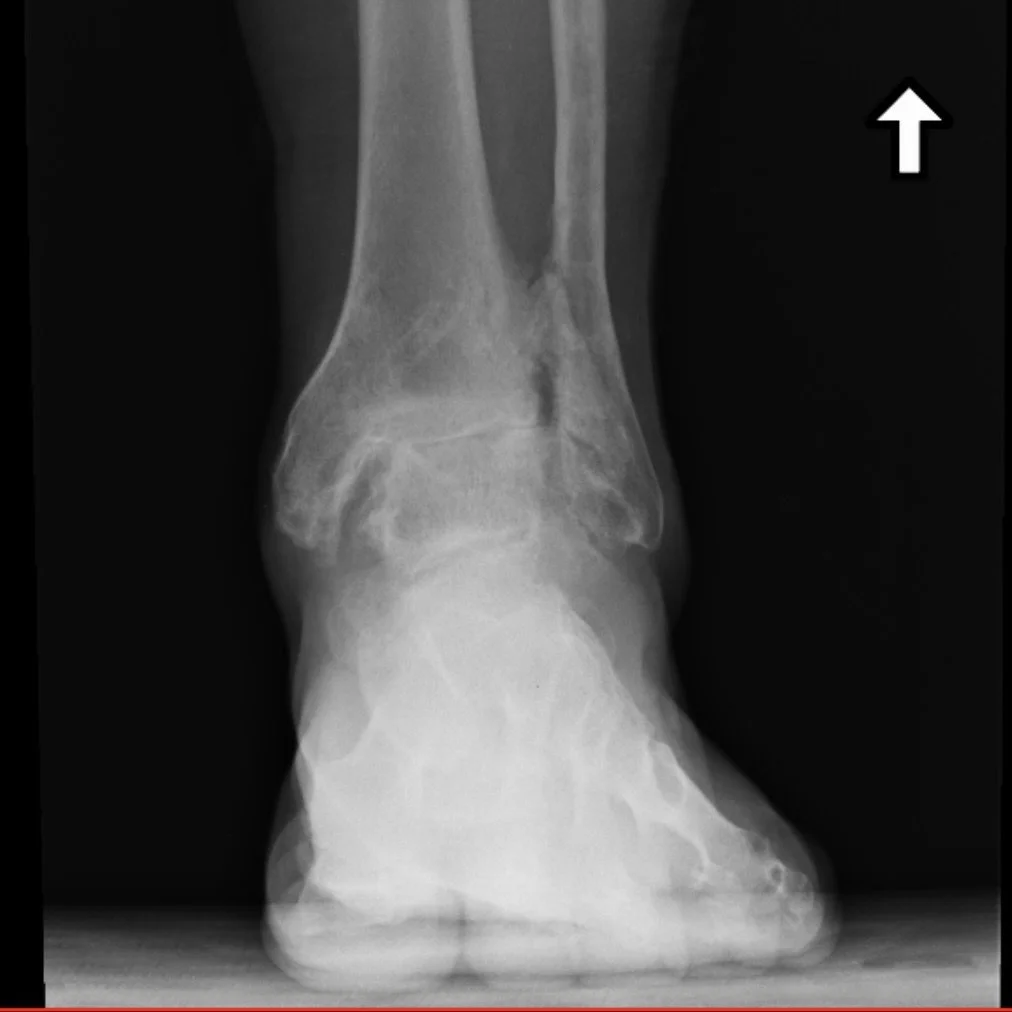
That’s where I’m at with my left ankle. That’s where I’ve been for most of the last decade.
I’ve tried a plethora of minimally and moderately invasive treatments. I’ve done all the bodywork, arthroscopic surgeries, PT, acupuncture, dietary + lifestyle changes, emotional and energetic work, prescription meds, supplements, cortisone injections, wearable prosthetic devices, more self-care modalities than I can count… All in hopes of delaying a tibiotalar fusion or an ankle replacement because of how dismal the prognosis for these treatment options is for someone as “young” as I am.
Long story short, the earlier in life that you fuse or replace your ankle, the likelier it is that you’ll eventually need a below-the-knee amputation and the sooner that’s likely to occur.
This August, my husband Austin told me that he thought it was time to really do something to address my pain and impaired function. That he didn’t think I realized how much I’d lost, how small my life had become. That I deserved to try to find some freedom and pain relief in my middle years instead of trying to keep kicking the can down the road any longer than I already have.
I surprised both of us by immediately agreeing with him.
So we went to see my ortho. I asked him the question I always ask when I need a healthcare provider to shoot me straight: “if you were me and this was your ankle, what would you do?” Thankfully, he’s fairly optimistic about 4th gen ankle replacements and thinks that’s probably our best bet.
The problem? We can’t really do that until we take care of another issue first.
Enter my upcoming surgery: a subtalar fusion.
When you develop end-stage tibiotalar arthritis as early in life as I did, the question isn’t IF you’ll develop arthritis in your adjacent subtalar joint, but WHEN. And according to my doc, if we go ahead with the replacement without addressing the subtalar joint first, it’s like building a house on a foundation that you know is going to go to shit sometime in the next decade. If you’re lucky, maybe you’ll be able to fix the foundation with the house on top of it, but that’s like betting on a long shot and honestly pretty stupid.
So we fix the foundation first. He’ll scrape out the cartilage between my talus and my calcaneous and screw them together so they can heal into a solid block of bone.
The big bummer is that very little of my pain is currently coming from my subtalar joint. So I’m about to have a pretty major surgery with a recovery that begins with 8 weeks non-weight bearing that won’t actually do much for me even after I’m healed (except prep me for surgery #2, which is hopefully happening in mid to late 2026).
I love being the good patient — the compliant one, the brave one, the rational one, the well-informed one.
I hate being scared when I think it might inconvenience someone else, but y’all, I’m scared.
Even though I’ve had six ankle surgeries, I haven’t had a “big deal” surgery since I was 19.
A lot is different now. I’m in a 41 year-old body. I have adult financial responsibilities. Last time I had a surgery that required a non-weight bearing recovery, I had a network of care that supported and held me in ways I didn’t fully recognize or appreciate at the time (probably pretty typical for most 19 year-olds).
Being without close relationships can sometimes be painful in “regular life,” but it feels extra hard and sad right now.
Despite it all, here’s what I know…
For the last five years, I’ve been budgeting my steps every moment that I’m awake.
I can’t take my dogs on walks. I struggle to make it down to the lakeshore from even the closest, flattest parking lot. I haven’t been able to wander aimlessly in the woods — something I’ve loved since childhood — in several years. I don’t even bake anymore because it makes a mess and I worry about having the stamina to stand at the sink and take care of the dishes.
I structure all of my days around making sure I have substantial time for horizontal rest.
Austin was right — my life has gotten very small.
And as scared as I am, I’m ready to try to make it bigger again.